The show opens with Wholly going to a Cholchester excavation site, and finding a board game which is already set up , he later take's the game to Dr Irving Finkle who works at a museum but has a soft spot with ancient games.When Finkle was shown the game it amazed me how much information about the game he could extract just by looking at the positions of the pieces and the structure of the board.

( A Roman copy of the Stanway game)
When i fist saw the board it did remind me of draughts, with the same shaped counters, different colours and the square layout if the board, but Finkle says that the Stanway game is probably ( like most other games) is to trap the opponent by taking a turn each.
Because a Roman copy of the Stanway game was made, Finkle came to the conclusion that games were sometimes played for real life situations and educational reasons, with the examples of Risk and Monopoly given. In Risk you learn different countries, how to become strategic and have an insight of invading countries, Where as with Monopoly you become money wise, you still go in jail even though you own most of the locations and you that Mayfair is the best place to buy.With years of playing monopoly I can say that i agree with Finkle, Though the main thing I learnt was the best place to buy and add hotels are the brown place's, purely because you have a community chess and a Chance card which takes a player there, the chances of landing there is higher then that of Mayfair or Parklane, the Hotals are cheap and most of all, it is a brilliant way to slowly watch your opponents lose because they landed in the 'crappiest' location.
Another game Wholly examines is The game of Gospels which was made my King Aphstan and yet again resembles the attributes of a chess board, thought with this one the layout the the board was different in which there is a substantial difference in the amount of counters on each side.
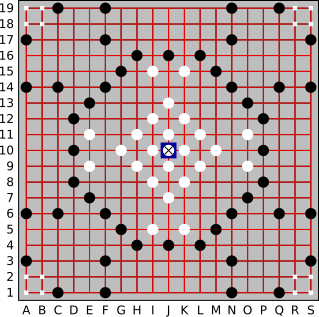 (Game of Gospels)
The aim of the game is using strategy to get the king (The centre white piece) to one of the 4 corners. Wholly says again that this game was used for real life situations, especially in the roman era and was related to Christianity.
Looking at it in a board game aspect, to me it resembled Jesus' difficult mission. With the small amount of white counters resembling Jesus' disciples and the opponent being the Romans, the non believers and 'the Devil' . We all know that Jesus succeeded in his mission, but just looking at the game looks impossible for the white counter to win. When watching Wholly play I could see that he was really thinking about every move he made and like he said "was easily 'in the zone'". Though we do have games like Chess, Backgammon and checkers, which require a good deal of thought and strategy, games like 'Game of Gospels' and 'Stanway Game' are different in ways that you can relate the game to real life situations.
As time went on, games lost their seriousness and instead of turning into fun, they took a rather 'demonic' turn. During the 14th century the "Devil temple game" as the people of that time called it ( we know it as hazard) began to spread. Chance games began to take over and the addictivness of it caused a lot of problems.
Personally I think that it is ridiculous to call gambling a 'Devil game' When you win in snakes and ladders, you win. nothing else, sure its a nice feeling, but wouldn't it be better to win on the roulette and get cash out of it? On the other hand if you lose in S&L then nothing is lost (but your dignity), whereas gambling...it could be a problem. When it comes to gambling it totally depends on the player, when I go to casinos, I leave my card at home, take a set amount of money, and play, whether I win or lose, I don'f feel regret or remorse (especially when i win) it was my choice to go, I had fun.
What amused me was that dice were classed as evil, and so in the 'royal game of goose' instead of using dice they used a spinning top with numbers...WTF is all I'm saying.
Like Wholly first says in his introduction, that games have a history, I thought he meant that there was a story behind it... little did I know that snakes and ladders was actually inspired by an Hindu game called 'Gyan Chaupar' When showing us the original board game I noticed clear similarities... but with the original, it had a deeper meaning, it wasn't all for fun, but also a game of enlightenment, it get to the very top of heaven with Vishnu. I haven't played snakes and ladders for years now, but i would gladly play Gyan Chaupar. With the majority of each square containing your stage in life and the educational element in it, I can see how this game was popular. Because of the snakes and ladders evolution from a Hindu game, it makes me wonder about other games, what if Operation was based on an ancient Aztec ritual where priests had to pick parts of a body out? or Mousetrap was originality played was played with cows and cowboys? maybe one day game will be made about protecting the earth (the ozone layer) from invading aliens (The humans using up fossil fuels)


Snakes and ladders compared to Gyan Chaupar. Though snakes and ladders looks more aesthetically appealing, Gyan Chaupar has a serious tone to it, and the pictures look more artistic
So far watching this show has been interesting to say the least ,I learnt that Roman played a bit of the Stanway game before going into battle, Games have evolved just like humans and surprisingly board games have a rather dark history. I thought this is something that you have to watch to understand how to make a good game, and just like Finkle said
"Because of games, it separates us from animals, we have the tendency to get bored easier then other animals"
I am excited to watch the next episode

i enjoyed reading this Leah, it shows a real engagement with the material. The other episodes are equally fascinating.
ReplyDeleteI too found the section on the so-called "Stanway game" fascinating. It wasn't a Roman game though, but a British game, dating from the time of the Roman ocupation.
ReplyDeleteI'm not sure King Aethalstan invented Alea Evangelii, but the programme notes that he is given credit in an illuminated manuscript for having the game in his court.
I like the way you've taken the time and trouble to find relevant images to illustrate the blog post.