Thursday, 29 March 2012

Remediation

We call the representation of one medium in another remediation, and we will argue that remediation is a defining characteristic of the new digital media.  

In 1970 it was thought that film were going to be taken over by the gaming industry, luckily that theory never came true, instead, games are now as popular as the film industry; so popular that the success of games are measured the same way films are.  Bittanti says that in U.S 90% of the households there have owned/own a computer or game console (I  would have thought at least 95%, minimum). Because of the popularity of games, some of the top universities now offer a games relating course.

Bittanti calls the gaming industry a 'complex phenomenon'. I personally don't see why its so complex. Jumping from  non digital gaming (board games) to digital gaming was a big, easy and successful change to adjust to. From looking at dull colours of the board to flashy brighter one on the screen and listening to sound and music (which i will admit is sometimes annoying) There is no reason why the digital gaming shouldn't be such a phenomenon.
Marshall and Morns says 'game culture does not fit into the past form of media' I think that games are unique in the media field, it is different to films and pictures.
It's sad that in today's world, games are still not taken seriously, even though some consoles and games actually help people e.g on the Wii we have Wii fit to make exercising fun for the player, we have games like rock band to help teach people how to use instruments, even on some hand held consoles we have brain tracing and puzzles to engage the player's brain. Scholors says that films are now influenced by games, and it didn't take me long to think of some examples, films like Drive, Death race, Fats and Furious all have attributes of Grand Theft Auto. In some films they make a film purely based on games, e.g  The Street Fighter franchise has no story (unless you count each players personal story) but in the last 2 decades they have made film adaptions to the game.

Overall i think that the gaming industry and the film industry are not merging into each, nor are the competing, i think that they are working side by side, inspiring idea to each other

Live dangerously but within the law


In this film, where the game is to kill without any consequence, the main character and hunter Meredith Caroline has her new victim called Marchello Polletti.

In the 'Big Hunt' you follow 4 simple rules

Rule 1: Every member has to commit a murder
Rule 2: The hunter knows everything about the victim
Rule 3: The victim does not know who their hunter is
Rule 4: After killing your 10th victim you are named 'deatathlete'

When the hunter has killed their 10th victim, they will 1 million euros. We follow Meredith through her journey to try to re-create the perfect kill for a t.v commercial. Over the span of the film we question whether the two have actually fallen in love we each other.

This film reminded me so much of the Hunger games and Battle royale, where the whole story revolves around a game of killing to win. I didn't really like this film, purely for the shameful reason that i didn't like the visual( i know that it was made in 1965, and i tried hard to ignore that fact but in a film when there are killings, i would have at least liked to see some blood to make the gun shots more realistic).

In the game designer point of view, i picked up on some game fundamentals.

Setting: For the commercial they wanted Meredith to Kill Polletti in Venus temple. Out of all the amazing spectacles in Rome, they chose a run down temple for the reason the Meredith is a beautiful woman, Venus being the Goddess of love, and the power ot manipulate men.

Keeps the player in suspense: Throughout the film we never get a clear answer of whether the both love each other, until the end.

Winning: Winning the Big Hunt, gives the players exceptional reviews and a sense of grand achievements

Character: In my blog about game Britannia 3, Lara Croft became a popular choice of game because of her gender and her personality. In the film, Meredith (and many other women in the film) is shown to be wearing  sexy outfits, with a gun always by her side.

Gender in Games

You wont need to do alot of research to know that the gaming industry is lacking female workers. 30 years ago  where the video gaming industry was starting to stand on its own two feet, the target audience were men. Only in the past decade have woman been noticed in the industry, but as Prescott and Bogg show in their article, it seems that the gaming industry is still male dominated.

Prescott and Bogg talk about the employment of women in the industry. They list a few points about what are the main issues are in segregation of the gaming industry :

- Young people are still choosing jobs in which their gender in represented.
-Women are both underrepresented in the games industry workforce as a whole and in certain roles within the industry
-Women in the industry tend to be concentrated in more traditionally ‘feminine’ roles e.g Marketing
- Women are underrepresented in some of the main game production e.g coding, art, designing etc

Their facts show that only 0.4% of women in UK are in lead (which include director, and management roles). Their research from Haines  show that 23% of senior positions were held by women, yet the catch is that senior positions meant managerial and less technical roles rather than direct game development.

Looking at chart for the 2009 'percentage of UK population playing games and time spent'  you can see that males have a higher percentage for playing games then females, but only slightly. the rest of the charts seems to have the same sort of percentage outcome to the first one.
From the fact sheet it shows that a lot females do play games, almost on par with males, so why is there still s major difference with female to male ratio in the gaming industry? From what Prescott and Bogg say, i believe that 'young people who chose jobs that represent their gender' plays a huge role in this. But with the increasing amount of females playing games and getting interested in the field of gaming, maybe in the near future we will see the female ratio increase.

Wednesday, 28 March 2012

Game Britannia ep3

The thrid and final episode of games Britannia  is about how video games were developed from board games and how in almost every modern we can see elements of some of the first video games ever made.

Quickly following the popularity of board games, video gaming took over the family fun board games. The first affordable video game was spectrum. When i saw this game, the colours, the music and even the screen would have annoyed me if i played it in this day and age, but when the public had first laid eyes on it, it was a new and fascinating sensation to them. The rival of spectrum was the BBC micro. This game was for the more posh game fanatics, it's main feature was to make the player use their mind to win the game. Unlike  spectrum, BBC micro' gameplay was the main feature and in my opinion a better home game, where the Spectrum would be something you would mist like to find at an arcade.

Throughout the show Woolly goes through video games which have been popular over the years, starting with  Black and White.  


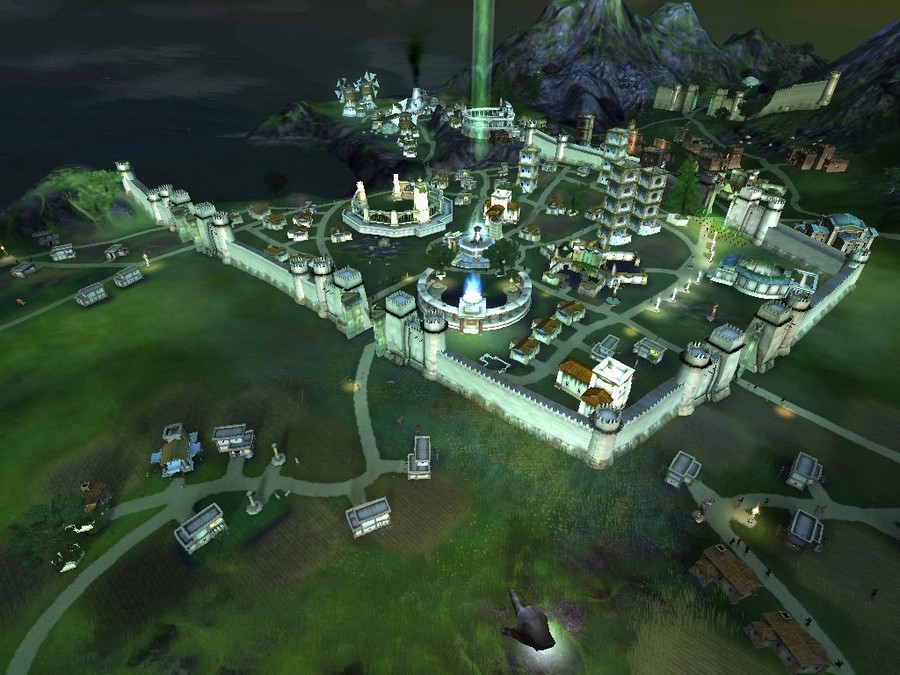
                                            (A city in Black and White)

In this game, the player is God over a civilization, you create the place, you choose what the people in your world do, you choose who dies or survive. Black and White features in sims, but with a twist, the whole game screams that you are in control, but in reality, you are the slave to the people in your world. Without these people the game would not survive, and so you have to cater to there needs, essentially do what they want you to do, but in a nice and deceiving way. This game how ever, gives the player responsibility and the free will to test your morals( whos cares if you kill someone in a game, you wont get punished)

The 1990's 'the cool Britannia'

Tome Raider:
One of the first 3-D characters made. Woolly says that game designers tried to the players care about Lara Croft and that is why the game was such a great success, i however, believe that lara croft was such a success because she was this beautiful woman with comes from a rich family, and yet decides to get dirty in tombs, as well as wearing tight fitting clothes and using guns ( which of course was not the main reason young people brought the game, or so Woolly says)

Heavenly Sword:
You could say that heavenly sword was an upgrade to Lara croft, it had the same elements as Lara Croft, but this time, it was story driven. This game focused on the characters history and why she is doing what she does.

WipeOut (The future dimension)


Having personally played the original of this game, i can safely say that i can see why this was such an international hit throughout the world. The music was great, the colours and setting was not too over whelming  (a considerable nice change from the spectrum)and the idea of driving a floating car was something that you had to try out. 

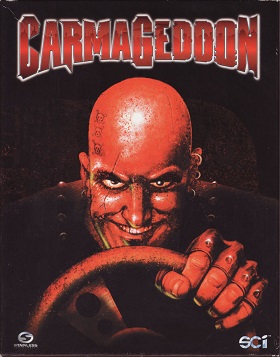
Carmageddon: 

Woolly says that this game was pushing the limits of morels of games, and when watching people play it, i can understand why. Running people over just too see what points you get sound like a strange objective of a game, but when playing games like Grand Theft Auto (which we might as well say is the grandson of carmageddon) the thrill of killing someone, or running away from police is what the game is about. GTA and carmageddon is letting the player release their inner devil inside through playing this game.


This final episode is a nice end to the ear of board games. It has taught me that board games were not all like snakes and ladders, and that video games weren't amazing at the start. Throughout 3 decades, video games kept evolving, keeping the best attributes and polishing up new ones and hopefully, at the rate the gaming industry is going, maybe in another 3 decades, we will have something that will make game in this time look like Spectrum.

Interactive storytelling

In this article Crawford says

'They don't bother with people other than as willing dolls the preform mechanical functions'


Crawford is explaining that in a game the story will have to live up to its fundamental expectations. If said expectations are not met then the players view and overall understanding of the game will be questionable and somewhat anti-climatic.
Crawford gives us 6 lessons on creating  successful story telling.

Lesson 1: Stories are complex structures that must meet many hard to specify requirements.
- Many games don't pay attention to the structural requirements needed in stories. Because of this lack of attention to this detail, games concern themselves with things instead. Example of Things are thing you obtain, things you use, things you destroy etc. Stories are not stories if it is about an object, rather it should be (and always should be) about people.

Lesson 2: Stories are about the most fascinating things in the universe: people.
- Just like lesson 1 it is the people that make the story. In games, they use conflict (specifically violence) to drive the story, it is simple, direct and a much more crowd  pleaser. Other conflicts include social, race and  indirect. In CSI puzzle is the drive of the show, they use science, photographs and amazing machinery  to help solve the crime, but it is the minds of the characters that fascinate the audience.

Lesson 3: Puzzles are not a necessary component of stories. 
- Stories are made by the choices the character makes and with that single (or multiple) decision the story will build up on that. Games have taken that idea and have added spectacle to it.  Spectacle dominants the film industry and is very close to dominating gaming as well. In my personal experience, I found that i shamefully do judge games on their graphics, I'm not sure if its because of the pretty colors how amazing the designers have created the game, but i recently played final fantasy 8 (rated the worst game play graphics in the series) and realised that it i love the game, the story, the characters, and most of all their personalities.

Lesson 4: Spectacle does not make the story.
-As a game player i do enjoy a little spectacle in a story, but I do admit that the minds eye is a much more satisfying element. Visual spectacle is limited , in games you would not be able to know the characters personality by just looking them,or be able to know what they were thinking. A spectacle is somewhat important in a game, but it limits the players imagination.

Lesson 5: Visual thinking should not dominate a story.
-I'm not sure if i read this lesson wrong, but i have to totally disagree with this lesson. In Lesson 4 a spectacle does not make a story, in lesson 6 stories take places on stages not maps. so what is in between? If a player cant use their minds eye to work on the story and there are not words on the screen to tell them what has happened in a certain amount of time, then surly they game should just flick between frames.

Lesson 6: Stories take place on stages, not maps
-Crawford give the example of saying that stories skip how the character arrives at a certain place, or what they did on their journey. In my opinion, if i was to read a story i would not like to listen to every detail of what the character did on their way to a place (unless it was important to the story or comical).

Crawford explanation on storytelling was insightful (event though i disagreed with some of his lessons) but the main conclusion to this is that it is the characters that make the story.  True it wouldn't be a very good story without visuals, objects and maps, but at the very core, characters are what makes a story enjoyable.

Types of Puzzles scott kim

Its not the most obvious thing you notice in games, but it is still there. Puzzles are apart of many games, either by themselves, within a layer of a game, on the web/ phone and in education.

The main concept Kim gives us, is that  a puzzle is "fun to solve" and has a "right answer" (opposed to everyday problems)
In Kim's article he gives us a pyramid of types of puzzles
(starting from top to bottom)

Games: the most obvious multiple puzzle game is chess, which is based solely on working out how to defeat the opponent.
Toy: There is no fixed goal, player is free to explore.
Experience: Non- interactive experience
Motivation: within motivations there are 4 main reasons people play puzzles
-deeper meaning : to find order in the universe
-Charater and setting: immerse self in into the story
-Challenge: people love challenges
-Distraction: from everyday life

Kim then tells us of 5 genres that puzzles can be found in.


Action puzzles:
-combines puzzle with time and pressure.
-you can recover from your errors,  e.g. in Tetris, if you make a mistake, focus on getting rid of it by getting rid of the lines.
- easy to learn from your mistakes

Story puzzles:
-Use's puzzles to tell the story.
- Makes the player think 'why is there a puzzle in the game?' what information does the puzzle give?
examples of this is 'Proffessor Layton' where you have to sole the puzzles given to you to continue the game.

Competitive puzzle:
-Multi-player, where each player plays a separate puzzle game.
-The main attribute of competitive puzzle is the scoring.

Construction puzzle:
-Combines solving puzzles with construction. e.g.  in some dungeons on Zelda,you would sometime have to move blocks of stone around to create an opening for a new room. In Neopets, to feed for your pets you would have to take different challenges/puzzles to obtain food.
-In Tetris, it uses Modularity ( meaning different pieces can fit together).

Pure puzzle:
-Puzzle solving is the focus of the game.

Kim's 8 steps to a finished game:
1. Inspiration
- By looking at other peoples games you can get inspiration from the artwork or gameplay mechanics.
- It doesn't necessarily have to be video games, board games have different mechanics from non digital games.

2. Simplify:
-When making a game, look at the bare essentials of it, there is no need to jump straight  designing irrelevant details of the game when it has just been born.

3. Editor:
-Test the game with to find faults.
-At this stage there is no need to worry about the art, just get the basic gameplay finished.

4. Specs:
- Gather all your information together. e.g make a design document.

5. Level Design:
- The level designer has to create individual puzzles and knows how to solve them.

6. Hinting:
- Let the player get frustrated enough to care about finishing the puzzle, but not enough to make them give up. Hinting keeps the flow of frustration in check with the player.

7. Testing:
- The only way to know if the game will be successful is if you have a small section of the public test it for you.

8. Presentation:
- The final piece is to add art, sound, user interface ETC...