Thursday, 3 November 2011

zotero

The result I got from Zotero (edit 27/03/2012)


Books:
Bell.R., 1979. Board and Table Games from Many Civilizations. Mineola, New York : Courier Dover Publications 


Fullerton, T., 2008. Game Design Workshop: A Playcentric Approach to Creating Innovative Games 2nd ed., Morgan Kaufmann.


Contributors:
Chandler, H.M. & Chandler, R., 2011. Fundamentals of Game Development, Jones & Bartlett Learning
Salen, K., 2006. The Game Design Reader: A Rules of Play Anthology, MIT Press.


Journal articles:
Jacobson, J. & Hwang, Z., 2002. UNREAL TOURNAMENT FOR IMMERSIVE INTERACTIVE THEATER. Communications of the ACM, 45(1), pp.39-42
Price, C.B., 2008. The usability of a commercial game physics engine to develop physics educational materials: An investigation. Simulation & Gaming, 39(3), pp.319-337.


Monday, 31 October 2011

Uncertainty and Inevitability


Our task last week was to read an article by Marc LeBlanc, it was about ‘Tools for Creating Dramatic Game Dynamics’. We had to read to see what tools were used. For the task I thought that it was another article about MDA, but in someone else’s words.
My theory was only partly right. In my last article it was clear that the designer of a game only has control of the mechanics, nothing more. In LeBlanc’s article he says the same about creating ‘Dramatic Tension’ in a game.

“We can only create the circumstances from which drama will emerge”

He then goes on to say what MDA is to him (which I still think Braithwaite and Schribier have a better way of explaining what it is)
The First tool we learn is ‘Aesthetic models’ which LeBlanc refers to as a yardstick to tell designers is the have achieved their design objective, but I think a better example is a spirit stick. If you tip it too far left or right (too much or too little) you have not achieved what you want, in our case being dramatic. To make a more visual example to make an aesthetic model, he introduces us to the    

                                                        “Dramatic arc” 


 The Dramatic arc is a general rule to make a game dramatic. With the climax at the highest point, the player will have to go though some sort of conflict. With the word conflict, it doesn’t always means battling with enemies in an RPG; it could challenge the player’s stamina (the T.V show Wipeout), test a player’s knowledge (you can find this in any game, at the pub, brain training or Prof. Layton) or see how fast a player’s reaction is.

LeBlac says the Drama is a product of two factors, saying that a game cannot achieve dramatic tension without these factors.

Uncertainty: When the outcome of the game is unknown (normally at the start of a game).

Inevitability: Nearing the end of the game, and the winner is pretty much clear.

Thou these factors give us a lucid meaning of creating dramatic tension; he dissects into two phases into a more detailed feature.


Force and Illusion is uncertainty split into two separate aspects.
Force is when the mechanics limits how much a player has an advantage over the other. We can see this example in Mario Kart Double Dash, when a player in 1st place in the race, the mechanics will not allow them to gain an accelerator if they run into a cube, whereas, if you are one of the clever lucky few, who linger at the back, you gain some of the best weapons to win.
Illusion is a talented way to manipulate a player perspective in a game. Within illusion you can find Hidden Energy, Escalation and Fog of War. Again in Mario Kart, hidden energy can be found when you are in one player mode. You have to complete a map in the shortest time. You have the hidden energy of 3 single mushrooms which boost your speed. I personally go on the baby park map, where it is only an oval shape. Once I have completed the map, I can go against my ghost and try to best my last score. Say in my second attempt at the map I use the mushrooms to give me an early lead with my ghost, I am at the advantage by being in the lead yet my ghost has 3 mushrooms to boost up their speed, and I have none. On the final lap, my ghost uses the booster mushrooms to get a head start, and I am unable to catch up with it since I wasted my mushrooms at the start. The Hidden energy tool at first seems like it should be part of the Inevitability tool, but the uncertainty kicks in when you know that the other player has a greater advantage over you, with this uncertainty in the players mind it is creating a test for them to use their skill to beat the other player.
You get weapons In Mario Kart to try and get 1st place and depending on what place you are in, the weapon can either aid you greatly or do nothing, this is where Escalation is being used. Without the weapons Mario kart would just be a normal racing game where the change in positions is quite slow throughout the game, but with weapons the position of each player can change within moments. If you are one of the ones at the back, and you are receive a Bowser shell (when released it skids around the race track and squashes anyone that is in the way, which slows them down greatly) you have a much higher and faster chance to overtaking a players and change the scoring positions .With Escalation, your position (score) changes faster over the course of the game with the weapons used.
Fog of war is slightly different from Hidden energy and Escalation. In Mario kart you can see the other player’s game view, but with Fog of war you are limited to what information you get. In the P.C game, Total Annihilation, Fog of war is heavily relied on as an uncertainty tool.
You start off as a single commander placed in certain point on the map. Even though you have the whole basic map given to you, unless you have scouter’s at your deploy, you know nothing about the other player’s army size, where they are placed on the map or how much energy and metal they are producing. By limiting the information you have, players can’t predict the game out come as the constant uncertainty of how big the other player’s army is always on the mind, making the game last longer. Once a player has produced a large enough army, they automatically gain more information of the map and with that; they have a greater success in winning the game.
            Other types of Illisonary Uncertainty include Decelerator, Accelerator and Cashing Out. The Decelerator is an object that slows a player down, thus changing the pace of the player in the game. By slowing the leading player down it gives the losing player hope, but the accelerator kicks in right after the leading player gets over the obstacle, this is where the truth is revealed and the giant difference is once again established and the uncertainty element has vanished into inevitability.
With Cashing out, the game reset after each round. At first I couldn’t think of a game using this technique and how it is connected to uncertainty, but playing Street fighter I became aware of the cashing out tool and how it created uncertainty. In Street fighter you have to K.O an opponent to win a round; once you have won 3 rounds you have won the game. The uncertainty is the fact that I have blistered my thumbs and cramped my hand in round 1… only to have to go though it twice over to win the whole game. With the resetting of the HP and the special bar, the opponent has a clean chance to win the round and even out the score.
LeBlanc gives us a wide range of Illusionary uncertainty, but only gives us 2 Force factors…which in to Illusionary factors hasn’t got as much variety, but the outcome is just as important.

Negative Feedback: making the game ‘close’ by making the scoring function as close to 0 as possible. (If you think of a racing game and the distance between the 2 cars is 7 metres, the smaller the distance the more tension is created between the 2 players’s)
Positive Feedback: Making the difference in score as large as possible (In Mario Kart, if you give a golden mushroom to the racer in front) this feedback gets rid of uncertainty and brings the game to a faster climax.

With negative feedback I think it is an important tool which gives back a dramatic tension, but with positive feedback I don’t think it is something that is needed. At the start of a game, if a player is guaranteed to have a massive head start, and have a great deal amount of success, then the dramatic tension is lost from the starting point.

As LeBlanc said once he introduced Uncertainty and Inevitability

“Tension relies on these two factors in combination-neither is sufficient by itself”

Just by reading LeBlanc’s article I am able to understand that the uncertainty tool is something that is important to create drastic tension, however, if we just stick to uncertainty the player would soon get bored or the feeling that the game would never end, ultimately making them quit the game. So I counter the ‘problem’ Inevitability is produced.
The main tool that is used is the Ticking Clock. This clock gives the player a HARD visual on when the game is about to end. In Ghost Recon, when you play split screen a small timer is always shown in the centre of the screen, thou it is miniscule the meaning of it shows the player that the game is coming to a conclusion.
The Ticking Clock isn’t just limited to the time on a screen. Other types of the Ticking Clock include the shrinking of a deck of cards (e.g Yu-Gi-Oh), the MP in final fantasy games, the game view (in bomber man, when then stage gets smaller and smaller until a winner is found) even in scrabble with the decreasing about of letters in the bag and the triple word spaces.
These types of ticking clocks could either be renewable or non-renewable; this changes the strategy a player makes. In Final Fantasy you can renew your health with items that you collect or buy. Knowing that you can renew your health easily relaxes the player. Though it does not create a massive dramatic tension, it makes the player try out more exciting strategies and lets them try out different dynamics of a game. In Yu-Gi-Oh you cannot renew the cards that have been sent to graveyard; because of this you know that you only have one chance to use a card. This non-renewable clock forces the player to think much harder with their strategy on how to go about the game, as well as loading a great amount of tension each time a monster is sent to the grave; you notice the fall of the deck and the decreasing health you get every time you take a direct hit from the enemy.
With the ticking clock function, I think it goes hand in hand with force and illusion tools, together they make a game which incorporate the dramatic tension, but also tells the that they have a limit.


In conclusion to LeBlanc’s article, I think that these tools effectively create dramatic tension in a game. Before the article I didn’t think that that Tetris had a ticking clock tool ( when you get higher) or that in Mario party it has a cashing out and a escalation tool at the same time after the players complete a game.


PLEASE CAN THE COMPUTER GAMES COURSE GO ON A TRIP IN EUROPE?

Tuesday, 25 October 2011

MDA ..another formal approach to Games design?

Reading Hinkles article reminded me much of Doug Churches article about FADT but instead we are intoducted to MDA
Mechanics Dynamics Aesthetics  
The Mechaics being the only thing the game designer has control of ( like in Challeneges for a games designer, when Braithwaite says that Mechanics is 'how things work' 
Dynamics is how the rules interact with each other. I  have the most trouble trying to understand the full concept of Game Dynamics, but an example I can use to describe it is Tetris, the mechanics is if you get a full four row of bricks, they disappear, the dynamics of it is the increasing speed of the falling bricks, and the the challenge for the player to try and get a full row of bricks . And finally Aesthetics, at first I thought this meant the overall look of the game, but in games designer vocabulary it means something more then that case.Aesthetics is what the player emotional feels towards a game and their emotional response and connection to a game. When i found this out i thought to my self, what games that i have played cause me to have an aesthetic response to it? I remember once playing Mario on the original gameboy, and i could see a green warp tunnel... but i had no idea how to get to it...what emotional reaction did I get from that?...feeling like a failure because I thought I knew all the secrets about the game.


Hinkle says that designers and players have a different perspective to MDA, he use's a a flow chart to show what he means.
                   
Designers ------------------------------>
               Mechanics Dynamics Aesthetics  
                <------------------------------- Player     
As the designer you ONLY have the control to make the mechanics, as it is the designer sets the rules, the dynamics is something happens because of the set of rules the designer has made, and the aesthetics is totally up to the player. A game designer cannot make a game for everyone to enjoy.. It is just like Doug Church said   in The Gamesutra 'game designers can discuss "fun" or "not fun," but often the analysis stops there' As games designers, we are trying to rid the gaming world of simple and vague worlds like 'fun'
As the player, they are more interested in the aesthetics of the game, as it is the reason they have purchased the game, though once they have completed the game, whose to say that they don't replay the game to look at the dynamics or better yet, the mechanics of the games.


Reading this article gave me a better understanding of the formal vocab in the gaming world, and have a clearer ( yet not a full understanding) of the word dynamics.
As for the systems used in the article, i think that it is a successful way to make a good game.

Sunday, 16 October 2011

Games Britannia

Anyone who is interested in games should watch Games Britannia presented by Benjamin Wholly. At first i was a bit skeptical about watching a shows about the history of games, but as the show continued I found that the history of game wasn't always as fun as they are now.

The show opens with Wholly going to a Cholchester excavation site, and finding a board game which is already set up , he later take's the game to Dr Irving Finkle who works at a museum but has a soft spot with ancient games.When Finkle was shown the game it amazed me how much information about the game he could extract just by looking at the positions of the pieces and the structure of the board.
                                                      ( A Roman copy of the Stanway game)
When i fist saw the board it did remind me of draughts, with the same shaped counters, different colours and the square layout if the board, but Finkle says that the Stanway game is probably ( like most other games) is to trap the opponent by taking a turn each.

Because a Roman copy of the Stanway game was made, Finkle came to the conclusion that games were sometimes played for real life situations and educational reasons,  with the examples of Risk and Monopoly given. In Risk you learn different countries, how to become strategic and have an insight of invading countries, Where as with Monopoly you become money wise, you still go in jail even though you own most of the locations and you  that Mayfair is the best place to buy.With years of playing monopoly I can say that i agree with Finkle, Though the main thing I learnt was the best place to buy and add hotels are the brown place's, purely because you have a community chess and a Chance card which takes a player there, the chances of landing there is higher then that of Mayfair or Parklane, the Hotals are cheap and most of all, it is a brilliant way to slowly watch your opponents lose because they landed in the 'crappiest' location. 
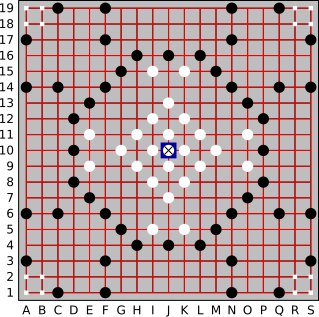
       Another game Wholly examines is The game of Gospels which was  made my King Aphstan and yet again resembles the attributes of a chess board, thought with this one the layout the the board was different in which there is a substantial difference in the amount of counters on each side. 
                                                                                                 (Game of Gospels)
The aim of the game is using strategy to get the king (The centre white piece) to one of the 4 corners. Wholly says again that this game  was used for real life situations, especially in the roman era and was related to Christianity.
      Looking at it in a board game aspect, to me it  resembled Jesus' difficult mission. With the small amount of white counters resembling Jesus' disciples and the opponent being the Romans, the non believers and 'the Devil' . We all know that Jesus succeeded in his mission, but just looking at the game looks impossible for the white counter to win. When watching Wholly play I could see that he was really thinking about every move he made and like he said "was easily 'in the zone'". Though we do have games like Chess, Backgammon and checkers, which require a good deal of thought and strategy, games like 'Game of Gospels'  and 'Stanway Game' are different in ways that you can relate the game to real life situations.
      As time went on, games lost their seriousness and instead of turning into fun, they took a rather 'demonic' turn. During the 14th century the "Devil temple game" as the people of that time called it ( we know it as hazard)  began to spread. Chance games began to take over and the addictivness of it caused a lot of problems.
     Personally I think that it is ridiculous to call gambling a 'Devil game' When you win in snakes and ladders, you win. nothing else, sure its a nice feeling, but wouldn't it be better to win on the roulette and get cash out of it? On the other hand if you lose in S&L then nothing is lost (but your dignity), whereas gambling...it could be a problem. When it comes to gambling it totally depends on the player, when I go to casinos, I leave my card at home, take a set amount of money, and play, whether I win or lose, I don'f feel regret or remorse (especially when i win) it was my choice to go, I had fun.
 What amused me was that dice were classed as evil, and so in the 'royal game of goose' instead of using dice they used a spinning top with numbers...WTF is all I'm saying.

Like Wholly first says in his introduction, that games have a history, I thought he meant that there was a story behind it... little did I know that snakes and ladders was actually inspired by an Hindu game called 'Gyan Chaupar' When showing us the original board game I noticed clear similarities... but with the original, it had a deeper meaning, it wasn't all for fun, but also a game of enlightenment, it get to the very top of heaven with Vishnu. I haven't played snakes and ladders for years now, but i would gladly play Gyan Chaupar. With the majority of each square containing your stage in life and the educational element in it, I can see how this game was popular. Because of the snakes and ladders evolution from a Hindu game, it makes me wonder about other games, what if Operation was based on an ancient Aztec ritual where priests had to pick parts of a body out? or Mousetrap was originality played was played with cows and cowboys? maybe one day game will be made about protecting the earth (the ozone layer) from invading aliens (The humans using up fossil fuels)
                      
         Snakes and ladders compared to Gyan Chaupar. Though snakes and ladders looks more aesthetically appealing, Gyan Chaupar has a serious tone to it, and the pictures look more artistic 

So far watching this show has been interesting to say the least ,I learnt that Roman played a bit of the Stanway game before going into battle, Games have evolved just like humans and surprisingly board games have a rather dark history. I thought this is something that you have to watch to understand how to make a good game, and just like Finkle said 
 "Because of games, it separates us from animals, we have the tendency to get bored easier then other animals"
I am excited to watch the next episode 

Saturday, 15 October 2011

Churches Article On Game Tools

Last week we had to read Doug Church's article about the tools used in games and how they were used... i had to read his article twice to grasp what the 'tools' were. But in the end it was Brathwaite and Schreibar who made me 'understand' the tools of games. With Church's article the main tools he talks about are:
Intention -  Making an implementable plan of one's own creation in response to the current situation in the game world and one's understanding of the game play options.
 Perceivable Consequence  -  A clear reaction from the game world to the action of
the player. 
    Reading Church's article was a bit of a tedious, but his argument about the vocab in the gaming industry being too broad and unclear made me realise how often i call a game 'fun' or'good'. 
      It's these type of words that makes a game complicated or 'hard' to review . 
Using Formal Abstract Desgin Tools (FADT) does make it clearer and set a better understanding of what someones opinion of a game is. Thou I have to say that the choice of words that Church uses are unnecessary and if anything  making the issue more complicated then it already is.
One of my course mates had the same view as me, thinking that Church is trying to make Computer games designing more academic. I was leaning more towards his opinion the the rest of the class.
Aswell as reading Church's article we had to read chapter 2 of Challenges for Games designers by Brathwaite and Schreiber.
     Putting Church's article aside, Brathwaite and Schreiber used much simpler terms which were more understanding and easier to grasp what they wanted to get across.
Using words like:
Game state- a collection of all relevant information that may change during gameplay 
Avatar-Something that represents the player in the digial world
Game View- A portion of game state which the player can see
Game Space- The entire game area 
Game Bits-  Where a physical objects are needed to play the game (e.g dice, control pads,cards e.t.c.)
Game mechanics- "if  you do X then Y happens. If X is true then you can do Y" pp28
Game Dynamics- (not to be confused with Goals) Once your into the game you have to 'finish' (like a race to the finish line in mario kart)
Theme and Goals are pretty my self explanatory for a games designer
   With the simpler words Brathwaite and Schreiber use's it is easier to understand the tools in a game and even simpler to review it.
   Church describes Mario 64 in a long text about the game play. Yet using the Brathwaite and Schreiber's 'tools' to describe a game.


Mario 64 (original) played on the Nintendo 64 ( Game Bits)
Throughout the game you use the same Avatar (Mario) When you start the game the Game View is at Princess Peach's castle (with 3 floors), yet Game space include's multiple areas though the passage on walls and painting. At the start the game state is mario is in Princess Peach's garden. With no special ability until if he jumps though a painting and enters a different world. You can collect all the invisable blue coins and defeat differnt monsters (Game Dynamics). To defect monsters Mario has different abilities, some moves you have to be in a certain area or have a specific surrounding, like the wall jump.

With the tools the using the tools that Brathwaite and Schreiber's have used I havee created a much shorter version of Chruch's explanation of Mario 64 game play.
  I think that Doug Church has a point about the confusion which is caused by mis-understanding people reviews of games, but his solution in using words like  Perceivable Consequence and Intention made me more confused, whereas Brathwaite and Schreiber have done the same as him but binned all the complicated words and dissected the games using their own simpler tools.

Paidea V Ludus

Last week we were introduced to the words LUDUS  and PAIDEA,  we had to read a section from James Newman's book about these words. Thou he does not give a precise definition about theses words he give a very good example quote from Frasca
"These  Ludus are hard-coded within the program" , What is a video game, Newman, pp20 "However the same mission-bsaed simulator could also be used for paidea: the player could simply not follow the rule and whould just play around with the airplane..."

Going with the what Frasca says i found it quite hard to think of games purely ludus or Paidea. On the other hand, I quickly thought games which would be possiable to switch between the
two.
-Final fantasy series - You have a main set mission throughout game, yet Square-Enix doesn't make it that straight forward,. Once you have completed the whole game you can go back to cities, redo missions or even play the different games they offer (final fantasy VII the Gold saucer amusement park, you can always go back and TRY to be the arm wrestling champion, but sometimes, sometimes, you cant be the best at it... NO MATTER HOW MANY TIME YOU TRY)


Fallout-  With the same game play as Oblivion and Dragon age, you have a set goal to achieve, however, you can kill who ever you want, get whatever reputaion you want or even just running around the waste lands, drinking the radio active water.


Gears Of War-  With GoW I had to think about whether it can be Paidea in the single or camplain mode. Ludus comes in when there's a locust horde, you can kill them with what ever weapon you can find, but once the horde has been defeated? No matter how long you stay in that area another horde won't come along. What else is there to do but to move on? I suppose you can move around and look at the area, but thats not exactly as fun filled as chain sawing  a locust .

Like Newman says, Ludus and Paidea are mainly seen in RPG's as you (usually) have the free will to do what ever you want ( as long as you play the the game worlds rule)
Newman then talks about Distinct Forms  which are
Agon- Competition
Alea-Randomness
Ilinx- The movement of the player ( Street Fighter series with the combos and moves you can preform)
Minicry- The players choice ( In Fallout you can 'make' your character to your own preferences)

Like Newman says these form are not exclusive, you can have more then one of these form in a game, like in Geomatry wars,  the agon, alea and a little but of ilinx can be witnessed in the game. the competition of killing the vast amount of enemies coming out at you and random times (Alea)  and the rippling effect on the screen when moving makes the game. Geomatry wars is one of my favorite games because the the challenge i have to face with the neon colored shapes, and the simple visual aspect of the game make it even better to indulge in the game.

Reading Newman' take on Ludus and Paidea was very interesting and educational, and more importantly set to a standard which allowed me to 'get' what he is explaining, unlike some other authors (Doug Church)
I can't think of a good game without Paidea or Ludus, and find it even harder to think that a game can be good without one or the other, especially without the forms of Alea,Agon,Mincry and Ilinx.
To design a game, I think it is essential to have these forms in. Without them a player would not be 'in' the game, as Newman quotes "Frasca encourages us to consider videogames as worlds, rather 'playgrounds'"
In the playground you have the fun of making up your own rules and image a world to your own liking, but the fall being that you have nothing to stop you from easily changing it, whereas a videogame, already has the structure pre built for you. What you do in it is entirely up to the player

Friday, 7 October 2011

Games Are A Structure Of Desire --> Whore House?

Costikyan says:-

'A game is an interactive structure of endogenous meaning that requires players to struggle towards goals' (2004:24) 


When i first read the statement i thought to myself  
1.Why the hell did this guy use such complicated words?
2. Why does he need 30+ pages to explain  gameplay? 
3.And what the hell does he mean that games are... endogenous, interactive, structural, tough and has goals.


It wasnt until i got onto the second paragraph where I started to have a clearer perspective of what Costikyan meant about games. Before Costikyans explanation about games and puzzle I didn't think there was any difference in the two. In simple terms, (which i understood) he give a clear difference between the two.
Where by a game can change with a players actions ( To which I thought of the achievements you can receive by killing a certain amount of people, or special cut scenes when you have played the game in a certain way) Where as a puzzle is 'static' and needs a logical way to complete the puzzle, you can only succeed or fail ( Crosswords, Sudoku, Wordsearch) At which to this point I feel like i have just touched the meaning of the statement.


Costikyan later talks about Will Wright and how Sim city over ruled Sim earth, and it was that  example of game that made me understand the statement ( a little more )
Sim earth, at the core it's really just a puzzle with a tiny bit if interaction, but the end result being you finish the game by having a life form on earth. Though I haven't played Sim city, i have spent a ridiculous amount of time on sims, which has every aspect of the statement 


Interacive: Being 'God' over my Sims I always changed the state of the game, I made Sims die (mostly because I just wanted to see what are the possible ways to kill them), I let them go to the toilets, I make them eat, I tired to make them happy e.t.c. All these commands I gave to them gave me a different result which in return I had multiple choice in how i go about them 


Endogenous: Lucky Costikyan explained what it meant. and gave a perfect example with the use of monopoly money.The  props in a game is exclusive to that game. Unless you have an extension to that game it is pretty much useless everywhere else


Struggle: To me this is one of the most important factors of gaming. Without the sense of a challenge or a level of difficulty you can never feel real satisfaction. I totally agree with what Costikyan says about ' A game without struggle is dead'


Goals: Goals and Struggle go hand in hand with each other, essentially the harder the level the greater the goal and so the greater the reward. Without a goal and just struggle you are just climbing an never ending rope... with your hands tied behind your back.


I do agree with Costikyns statement, it takes more then just entertaining the user once and never again can you change what you have down with a puzzle. A true game can have different and multiple changes made to it, depending on how the player chooses how to deal with certain situations. I am sure that there is a loop hole game that doesn't  go with Costkiyans definition, and I will be ecstatic if i did find one, but in general his definition is pretty solid in my opinion. This statement has given me a clearer view on the gaming genres and how hard it must be to have a game to keep a player entertained once they have completed the game.